Neil W. Cornish: “THE PRIVATE ISSUES” - A
Study into the Privately Issued Australian Airletters and Aerogramme
Issues of 1946 to 1966”
First edition, January 2014
Postal
authorities usually are restrictive when it comes to privately
manufactured stationery forms, which are offered in addition to (and
competing with) the official postal stationeries. The forms have to go
through a licensing process, which should guarantee that the forms meet
postal regulations and requirements.
The privately manufactured
aerogramme forms of Australia have the permit reference usually printed
in the lower left corner of the front panel, e.g. “Approved by
Postmaster-General for acceptance as aerogramme no. …”.
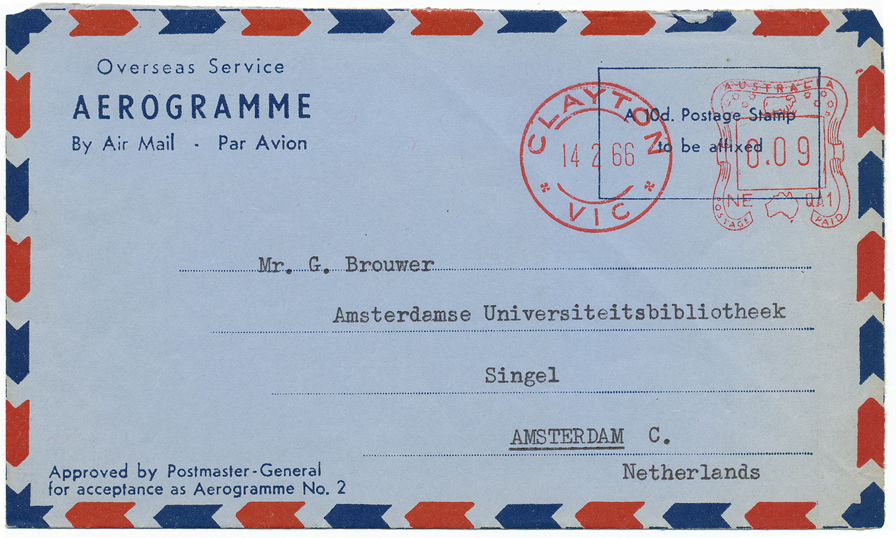
The
permit number refers to the manufacturer, not to the individual
aerogramme form. Hence, a manufacturer’s aerogramme forms, which can be
quite different in layout and printing, all have the same permit
number.
Neil W. Cornish has now published the very first in-depth study of
Australia’s pre-decimal privately manufactured aerogramme forms. Based
on extensive research in the archives of Australia Post, the author
gives details for permit numbers 1 to 61, including date of approval and
major layout variants, for which images are provided.
This
really is ground-breaking work, as stationery catalogues do not cover
the privately manufactured aerogramme forms. Collectors were never sure,
for example, if their collection is somewhat “complete”.
Neil W.
Cornish has made a big hit with his approach to provide a
collector-friendly, clearly laid out catalogue structure. The
information provided in the appendix, e.g. examples of official
communication pertaining to the approval process, is a very welcome
add-on.
The study is obtainable from the author at AUD 33
(within Australia) and AUD 45 (overseas), respectively, including
postage in each case.
If you are interested, please contact me via the email adress given at the top of this blog. I will provide the author's contact details, then.
Interesting aerogrammes and airletters from all over the world. Some (hopefully: most) of them with a nice story behind. Co-authors welcome! If you have any questions about aerogrammes, just email me at aerogrammeblog@gmail.com
Mittwoch, 9. April 2014
Montag, 7. April 2014
USA: 10c "Missing Propeller" Variety
This is Wiegand #4 (three-line admonition on back panel).
Below is a close-up of the indicum clearly showing the missing propeller, which was listed in the old Kessler catalogues. However, it is not in the Wiegand catalogue.
For comparison, here is the normal indicium
There are other differences as well. Steve Levine has published a good start for further investigations on his website.
Reference:
Wiegand, Katalog der Aerogramme von Canada, USA, UNO New York, 1994
Below is a close-up of the indicum clearly showing the missing propeller, which was listed in the old Kessler catalogues. However, it is not in the Wiegand catalogue.
For comparison, here is the normal indicium
There are other differences as well. Steve Levine has published a good start for further investigations on his website.
Reference:
Wiegand, Katalog der Aerogramme von Canada, USA, UNO New York, 1994
Freitag, 4. April 2014
Spain: Aerogramme with Special Postmark for UPU 75th Anniversary
This is Greiner #10c, the rare variant with overlay type B (light-grey, with wide sealing flap angle).
The aerogramme was cancelled with a special postmark commemorating the 75th anniversary of the UPU (Universal Postal Union) in 1949. Philatelic usage.
Reference:
Greiner/Greiner, Aerogramme von Europa, 3e, 1993
The aerogramme was cancelled with a special postmark commemorating the 75th anniversary of the UPU (Universal Postal Union) in 1949. Philatelic usage.
Reference:
Greiner/Greiner, Aerogramme von Europa, 3e, 1993
Dienstag, 1. April 2014
UK: "SPECIMEN" overprint
This is the 1965 Christmas commemorative aerogramme (Greiner #32).
Three types of "SPECIMEN" exist: Handstamped, either 13 mm wide in black or 23 mm wide in purple, and printed, 13 mm wide in black.
This is the rare type, with "SPECIMEN" printed in black.
Reference:
Greiner/Greiner, Aerogramme von Europa, 3e, 1993
Three types of "SPECIMEN" exist: Handstamped, either 13 mm wide in black or 23 mm wide in purple, and printed, 13 mm wide in black.
This is the rare type, with "SPECIMEN" printed in black.
Reference:
Greiner/Greiner, Aerogramme von Europa, 3e, 1993
Samstag, 29. März 2014
India Aerogramme: Color Variants
This is the 8.50 R "Panchmahal Fathepur Sikri" aerogramme. It exists in two color variants, most obvious in the different colors of the printing. Also the paper color is different but this is difficult to see on a scan.
Dark brown printing on greenish-grey paper
Light brown printing on greyish-green paper
Dark brown printing on greenish-grey paper
Light brown printing on greyish-green paper
Mittwoch, 26. März 2014
Nigeria: Domestic Aerogramme Used Internationally - Enclosure
The 20 k domestic aerogramme (NGK #20) was used internationally, which made an additional 20 k franking necessary to meet the 40 k aerogramme rate. There was a stamp attached which had fallen off, unfortunately.
However, as the aerogramme contained an enclosure the first reaction of the post office clerk was to divert the aerogramme to surface mail. Consequently, the “By Air Mail” routing instruction was crossed out and “Surface Mail” endorsed. The post office clerk then revised his/her decision and treated the aerogramme as an ordinary airmail letter, for which the aerogramme was short paid.
The postage due calculated was “25k”. This endorsement does not meet the UPU standard, which in 1979 was to give a tax fraction with single deficiency in the numerator and the first weight step international surface mail rate in the denominator.
Reference:
NGK, Aerogramme Afrika 2012
However, as the aerogramme contained an enclosure the first reaction of the post office clerk was to divert the aerogramme to surface mail. Consequently, the “By Air Mail” routing instruction was crossed out and “Surface Mail” endorsed. The post office clerk then revised his/her decision and treated the aerogramme as an ordinary airmail letter, for which the aerogramme was short paid.
The postage due calculated was “25k”. This endorsement does not meet the UPU standard, which in 1979 was to give a tax fraction with single deficiency in the numerator and the first weight step international surface mail rate in the denominator.
Reference:
NGK, Aerogramme Afrika 2012
Sonntag, 23. März 2014
Australia: Lettersheet - Aerogramme Rate not Applicable
These two lettersheets were issued by Trans-Australian Airlines (operating from 1946 to 1992) for surface mail use only. The admonition at the bottom of the front panel states that aerogramme rate were not applicable.
Abonnieren
Posts (Atom)


